
Upholstery cleaning in your city: what to expect and what you need to know first
 McCarthy James2026-06-09
Hi, I’m one of the senior technicians at Magical Cleaning. We’ve been doing professional dry cleaning of upholstered furniture for years, and every town has its own character – and its own kinds of stains. Let me take you through five recent jobs in the five cities we serve. I’ll tell you what we did, what we learned, and what you should keep in mind if you want your fabric sofas and chairs to last.
High standards of upholstery cleaning, no matter how complex the task, wherever you are
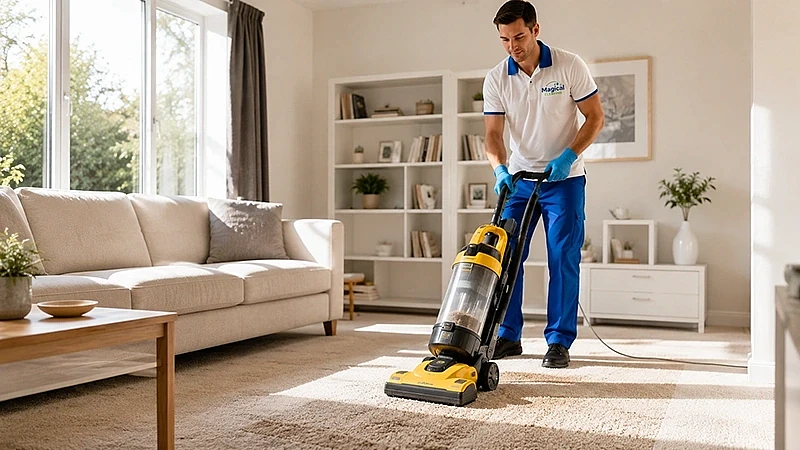
Magical Cleaning has been operating in the cleaning sector in Ireland for over 10 years, and during that time we have learned never to compromise when it comes to tackling all kinds of dirt and grime. Our quality control system and fully organised process, combined with our team of top-class, experienced cleaners, guarantee a high standard of service in every town and city where we operate.
Our experience and our customers’ feedback show that professional cleaning does more than just clean your favourite furniture, rugs, carpets and so on. We are referring to another factor that is important to our customers: maintaining the best possible appearance and ensuring longevity. In the long run, this directly saves you both stress and money.
Our unique approach to each client and in-depth analysis of the problem enable us to find the best way to tackle the dirt; and by the time the work is complete, our cleaners feel as though they’ve become part of your family and are delighted to see how pleased you are with the final result. You can see for yourself that our company offers the widest range of cleaning services and upholstery cleaning; you can view the full list of our services.
Today we’ll be sharing some examples of cleaning jobs in various cities where customers regularly turn to Magical Cleaning for help with their cleaning needs.
Kilkenny – A vintage velvet sofa attacked by red wine
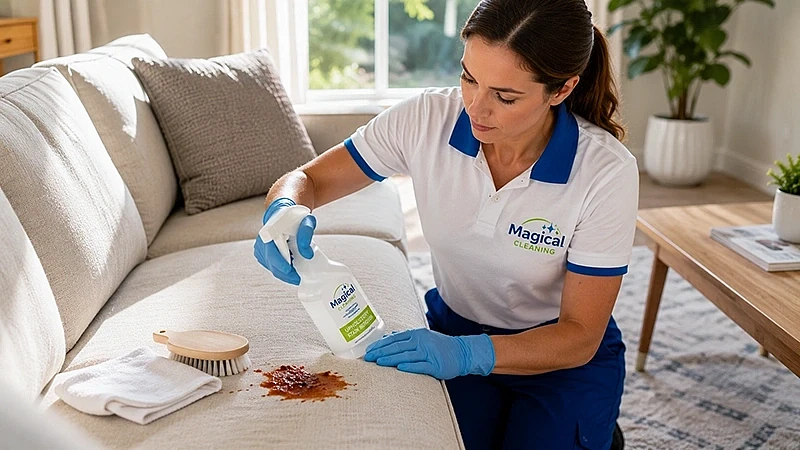
Last month, a lovely older couple in Kilkenny called us about their grandmother’s velvet sofa. It was a deep emerald green, absolutely gorgeous, but during a birthday party, someone accidentally tipped over a full glass of red wine. The wine soaked right through the pile and left a huge, dark purple blotch in the middle of the seat cushion.
Velvet is tricky – you cannot scrub it aggressively, or you’ll crush the pile and create a shiny patch. We started by blotting excess moisture with a clean, white absorbent cloth. Then we applied a specialised dry‑cleaning solvent that is safe for delicate fibres. Using a soft bristle brush, we gently worked the solvent into the stain from the edges toward the centre, letting it lift the wine residue without spreading. After that, we used an extraction machine with a low‑moisture upholstery tool to remove both the solvent and the dissolved wine. The result? The velvet looked like new – no trace of the party accident.
🧼 Technician’s note for Kilkenny homeowners:
Velvet and other pile fabrics (like velour or chenille) hate water‑based cleaning because moisture can make the backing shrink and cause the pile to lose its original feel. That’s why we always go for a dry‑solvent method. One crucial nuance: never rub a fresh red wine stain – blot only. Once it dries, it becomes much harder to remove, and you risk leaving a permanent pinkish shadow. Also, be aware that many vintage sofas have non‑removable cushions. In that case, we use a special backing pad to prevent the solvent from soaking into the foam. Another hidden risk is colour bleeding: some older velvets have unstable dyes. We always test a hidden area first. In Kilkenny’s damp climate, mould can also form under the fabric if too much liquid is used. That’s why dry cleaning is the safest choice for velvet.
Portlaoise – A microfiber sectional couch with months of cat urine
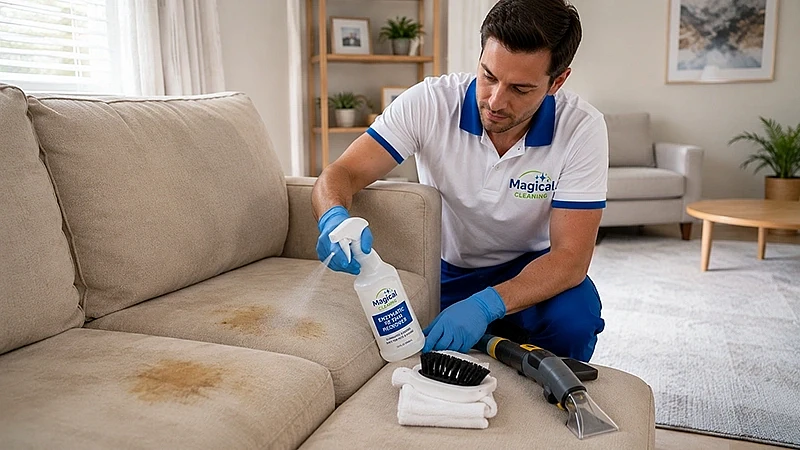
In Portlaoise, a young family had a huge, light‑beige microfiber sectional. They had two cats that occasionally “marked” the sofa, and over several weeks, the smell became unbearable. By the time they called us, the urine had dried deep into the cushion foam and the backing fabric. The stain looked like a yellow‑brown map, and the odour was strong enough to make you cough.
Microfiber is actually easy to clean once you know the trick. First, we vacuumed the entire sofa with a high‑suction machine to remove hair and loose dirt. Then we applied an enzymatic cleaner specifically formulated for pet urine. This cleaner breaks down uric acid crystals. After letting it sit for 10 minutes, we used a heated extraction tool to rinse and remove the enzyme solution together with the dissolved waste. For the foam inside, we injected a dry‑foam solution through the fabric without removing the cushion covers. A strong air mover dried everything in two hours. The smell was completely gone, and the colour brightened back.
🧼 Technician’s note for Portlaoise pet owners:
Pet urine is a beast because it contains salts and uric acid that crystallise and stay active even when dry. If you only mask the smell with a perfumed spray, the cat will smell it and come back to the same spot. You need an enzymatic cleaner that digests the biological residue. Another nuance: don’t use steam cleaning on urine stains – the heat can bake the proteins into the fibres, making the odour permanent. Also, never mix different cleaning products; some chemical reactions can release toxic gases. In Portlaoise’s humid summers, a wet cushion may take days to dry, leading to mould. That’s why we use a dry‑extraction method that leaves only 5‑10% moisture. Finally, always ask your client to show you where the cat sprayed – it’s often along the top edge of the backrest, not only on the seat.
Waterford – A dining chair set with stubborn cooking oil stains
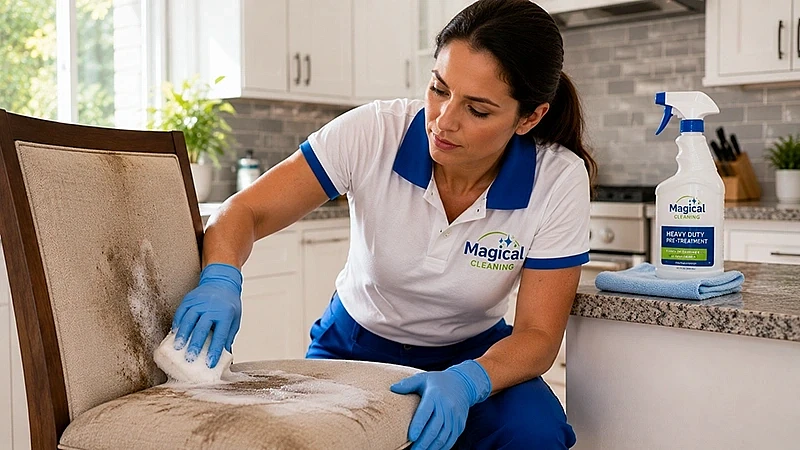
Waterford is known for its fine dining and home cooking. One of our regular clients runs a small B&B. She had six antique dining chairs upholstered in a patterned cotton blend. For months, guests had left greasy fingerprints, and splashes of olive oil and butter had seeped into the fabric around the front edges. The chairs looked uniformly dirty, with dark, sticky patches that attracted dust.
We started with a pre‑treatment: a dry‑cleaning absorbent powder that we sprinkled over all the oily areas. This powder pulls out liquid grease without wetting the fabric. After letting it sit for 20 minutes, we vacuumed it off. Next, we applied a citrus‑based solvent degreaser using a trigger spray and lightly agitated with a nylon brush. Then we used a dry‑cleaning foam that lifts the remaining oils and suspends them. Finally, we hand‑wiped each chair with a clean microfiber cloth. The result was spectacular – the original pattern reappeared, and the greasy feel was gone.
🧼 Technician’s note for Waterford hosts:
Cooking oil is one of the hardest substances to remove from upholstery because it penetrates deep and attracts more dirt. Water‑based cleaners will often spread the oil, making the stain bigger. The secret is to use a solvent that dissolves grease but does not wet the fabric. A common mistake is to scrub aggressively – that only grinds the oil into the fibres. Instead, blot and let the solvent do the work. For antique chairs, be extra careful with the wood frames: any solvent dripping onto the varnish can damage it. We always mask the wooden parts with painter’s tape. Also, fabric colour fastness is a concern – test the solvent on a hidden spot. In B&Bs, we recommend applying a fabric protector after cleaning; it creates a barrier against future spills. For cotton blends, heat can shrink the fabric, so we never use steam. Dry cleaning is definitely the way to go.
Carlow – A sheepskin rug and a furry armchair stained with grass and mud
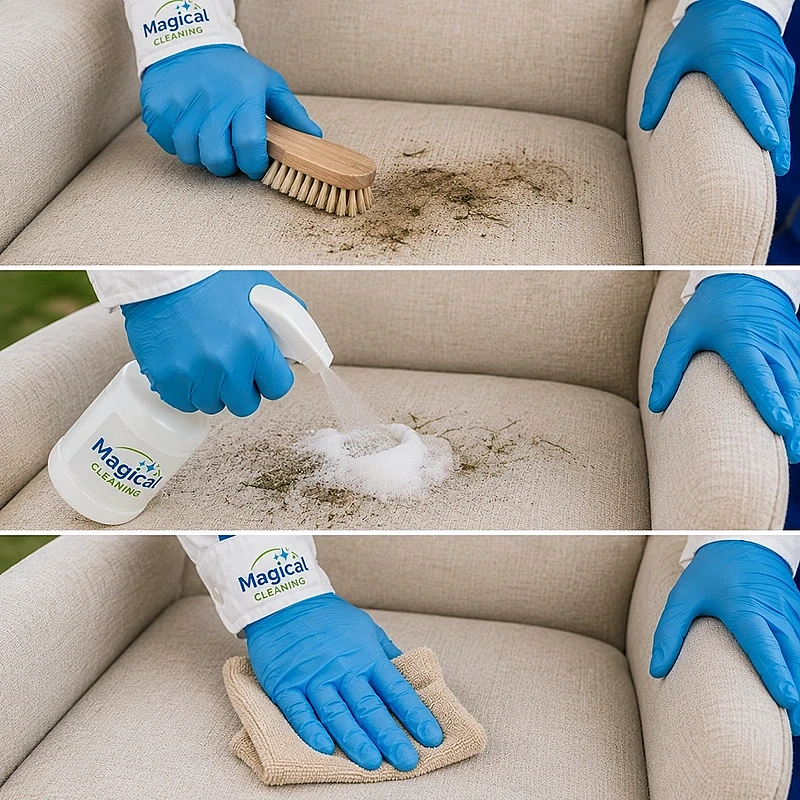
Carlow has many families with active kids and dogs. One mother called us about a natural sheepskin rug and a matching faux‑fur armchair in her living room. Both were covered in green grass stains and brown muddy footprints after a weekend of kids playing inside and a Labrador jumping on the furniture. The rug was especially bad – dirt had been ground into the wool, making it feel matted.
Sheepskin is extremely sensitive to water and alkalines. We used a neutral‑pH dry‑cleaning foam specifically designed for wool. First, we vacuumed both pieces thoroughly with a turbo brush to remove dry mud and loose fibres. Then we applied the foam and worked it through the wool using a soft horsehair brush, following the direction of the hair. For the muddy spots, we repeated the process twice. After 15 minutes, we vacuumed off the foam, which had turned grey from the lifted dirt. The rug regained its fluffy texture and cream colour, and the armchair looked brand new. No rinsing, no drying time – just clean.
🧼 Technician’s note for Carlow families:
Grass stains contain chlorophyll, which can permanently dye light‑coloured wool if left untreated. Mud is abrasive and can cut the fibres. The biggest myth is that you can throw a sheepskin rug in the washing machine – that will ruin the leather backing and cause the wool to felt. Dry cleaning is the only safe method. One nuance: after cleaning, we use a wide‑tooth pet brush to fluff up the wool again. For faux fur, never use heat; the synthetic fibres will melt. In Carlow’s rainy climate, mud often turns into clay, which requires a special clay remover before foam cleaning. Another insider tip: if the dirt is only on the surface, you can sprinkle baking soda and let it sit to absorb odours, but that won’t remove the stain. Also, always test colourfastness – some dyed furs can bleed. Finally, for sheepskin, never use solvents containing alcohol; they dry out the leather. We use a lanolin‑based post‑treatment to restore natural oils.
Tipperary – An office chair with years of sweat and body oils
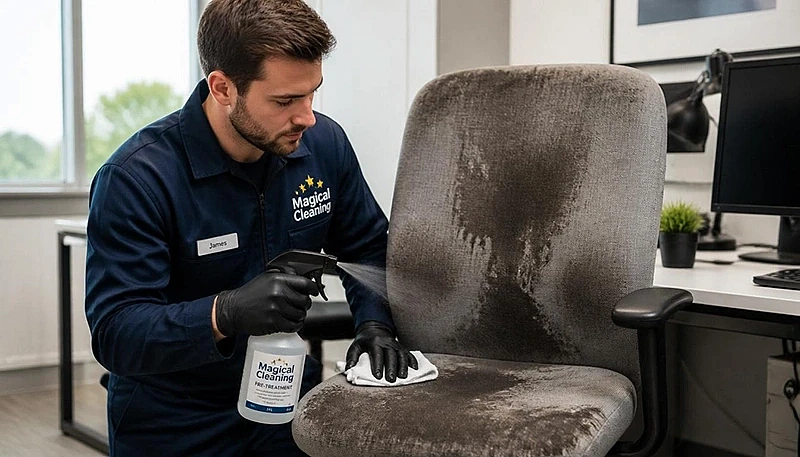
Our last story comes from Tipperary, where a local accountant asked us to clean his high‑end executive office chair. The chair was upholstered in a light grey microfibre fabric, but after three years of daily use, the backrest and seat were dark grey, almost black, from sweat, body oils, and hair products. There were also faint ink stains from a leaking pen.
Microfibre responds well to a dry‑solvent extraction process. We started by applying an ink remover specifically for ballpoint pens – it’s a gel that breaks down the dye. We let it sit for 5 minutes and then blotted it. For the body oils, we used a solvent‑based pre‑spray that emulsifies grease. After agitating with a soft brush, we used a portable extractor with a dry‑cleaning solution (a mixture of solvent and water, about 30/70). The extraction machine pulls out the dissolved oil and dirt without over‑wetting the foam. After two passes, the chair looked light grey again. The ink stain was 99% gone. The client couldn’t believe it was the same chair.
🧼 Technician’s note for Tipperary office workers:
Sweat and body oils are acidic and can weaken fabric fibres over time, leading to cracking or tearing. The biggest challenge is the foam inside the chair – if you over‑wet it, mould can grow, and the foam loses its shape. That’s why we always use a low‑moisture dry‑cleaning method. Another nuance: desk chairs often have plastic parts and gas cylinders. Some cleaning solvents can damage the plastic or dissolve the grease in the mechanism. We always mask the cylinder and use a shield. For ink stains, never use alcohol on microfibre – it can melt the fibres. Instead, use a specialised ink remover. A hidden trick: body oils tend to accumulate around the edges of the seat where the thighs touch; those areas may require multiple applications. Also, office chairs should be cleaned every 12 months, not when they become black. In Tipperary’s variable climate, humidity affects drying time, so we use air movers to speed up the process. Finally, always remove the chair from the base – many people forget to clean the back of the backrest and the armrests, which also collect a surprising amount of grime.
Why Professional Dry Cleaning Is Safer for Your Home and Your Furniture
You might think that cleaning your sofa yourself with a store-bought foam or a rented machine saves money. But after nearly a decade of working with upholstery, I can tell you one thing clearly: DIY cleaning often does more harm than good.
At Magical Cleaning, we don’t just “wash” fabric. We use professional-grade equipment that is calibrated to extract dirt without over-wetting the fibres. Over-wetting is the number one reason why foam inside cushions becomes lumpy, why mould starts growing, and why fabrics shrink or warp. Our low-moisture dry cleaning systems are designed to leave your furniture dry within two hours – not two days.
However, one of the key factors is the cleaning products we use on upholstered furniture.
All our cleaning solutions are specially formulated for dry cleaning of delicate upholstery. They are solvent-based or water-based hybrid formulas that lift grease, wine, pet urine, and protein stains without damaging the natural fibres. And here is the part that matters most to you and your family: every single product we use is certified for use in Ireland and has passed independent safety tests.
What does that mean for you?
- No toxic residues. Our solvents break down into harmless components or evaporate completely, leaving no chemical film behind.
- Safe for children and pets. You don’t have to keep your kids or your dog away from the sofa for days. As soon as the fabric is dry (usually within two hours), it is completely safe to touch, sit on, and even nap on.
- Eco-friendly by design. We avoid aggressive bleaches, phosphates, and volatile organic compounds (VOCs) that pollute indoor air. Many of our solutions are biodegradable and come in recyclable containers.
- Protection for the fabric. Professional dry cleaning removes abrasive dirt particles that cut fibres every time someone sits down. This dramatically extends the life of your expensive sofas, armchairs, and dining chairs. A regular professional clean every 12–18 months can add years to your furniture’s lifespan.
All our products carry the Irish Safety Certification and have been tested by independent laboratories for skin irritation, inhalation risks, and environmental impact. You can find the certification documents on our website – we believe in full transparency.
So when we clean your velvet sofa in Kilkenny or remove pet stains from a microfiber sectional in Portlaoise, you are not just getting a pretty surface. You are getting a scientifically safe, deeply hygienic treatment that protects your loved ones and your investment.
That’s the Magical Cleaning difference. To book a soft furnishings dry-cleaning service, please visit the dedicated page for this type of cleaning.
